


EM 1110-2-2907
1 October 2003
where λ is the wavelength (m). This means that short wavelengths will undergo a large
amount of scatter, while large wavelengths will experience little scatter. Smaller wave-
length radiation reaching the sensor will appear more diffuse.
c. Why the sky is blue? Rayleigh scattering accounts for the Earth's blue sky. We see
predominately blue because the wavelengths in the blue region (0.4460.500 m) are
more scattered than other spectra in the visible range. At dusk, when the sun is low in the
horizon creating a longer path length, the sky appears more red and orange. The longer
path length leads to an increase in Rayleigh scatter and results in the depletion of the blue
wavelengths. Only the longer red and orange wavelengths will reach our eyes, hence
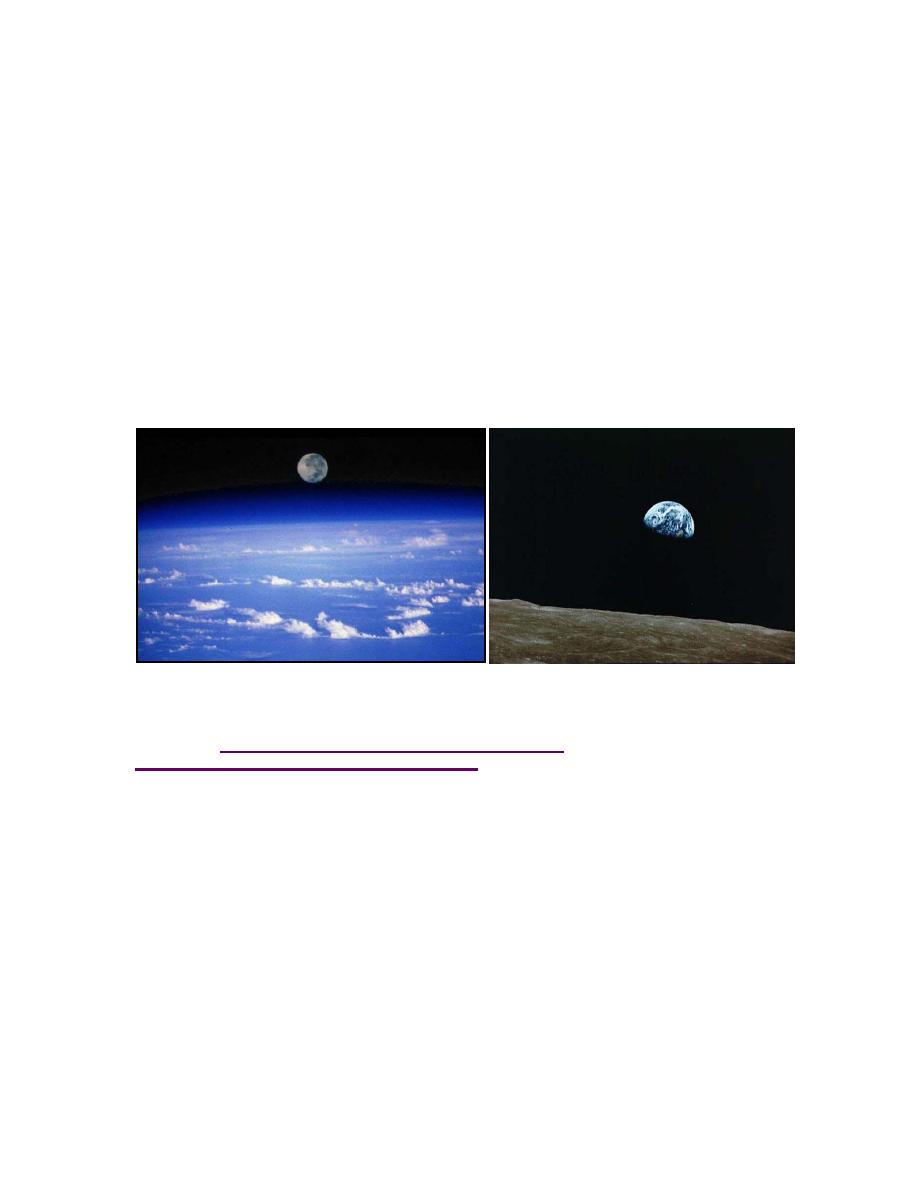
beautiful orange and red sunsets. In contrast, our moon has no atmosphere; subsequently,
there is no Rayleigh scatter. This explains why the moon's sky appears black (shadows on
the moon are more black than shadows on the Earth for the same reason, see Figure 2-13).
Figure 2-13. Moon rising in the Earth's horizon (left). The Earth's atmosphere appears blue
due to Rayleigh Scatter. Photo taken from the moon's surface shows the Earth rising (right).
The Moon has no atmosphere, thus no atmospheric scatter. Its sky appears black. Images
taken from: http://antwrp.gsfc.nasa.gov/apod/ap001028.html, and
d. Mie Scattering. Mie scattering occurs when an atmospheric particle diameter is
equal to the radiation's wavelength (φ = λ). This leads to a greater amount of scatter in
the long wavelength region of the spectrum. Mie scattering tends to occur in the presence
of water vapor and dust and will dominate in overcast or humid conditions. This type of
scattering explains the reddish hues of the sky following a forest fire or volcanic eruption.
e. Nonselective Scattering. Nonselective scattering dominates when the diameter of at-
mospheric particles (5100 m) is much larger than the incoming radiation wavelength
(φ>>λ). This leads to the scatter of visible, near infrared, and mid-infrared. All these
wavelengths are equally scattered and will combine to create a white appearance in the sky;
this is why clouds appear white (Figure 2-14).
2-16


 Previous Page
